
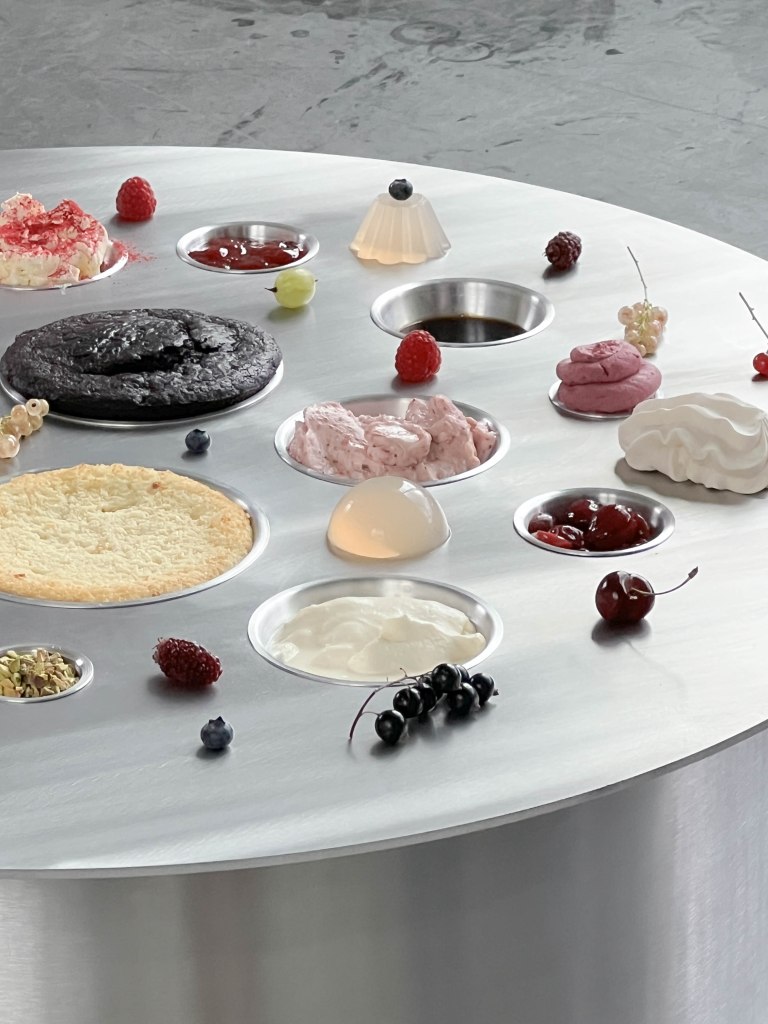
2024
Photograph by Alejandra Alarcón
Alejandra Alarcón is an artist and designer with a background in industrial and contemporary design. She migrated to Finland in 2020. Currently, she is working on a project called Edible Landscapes, where she makes sculptural cakes inspired by nature and the changing seasons. Her family background, seasonal ingredients and experimenting with recipes and flavours are at the heart of her practice. Each artwork culminates in a communal eating moment that brings together the artist and the audience. I sit down with the artist as she begins by reflecting on how the idea first came about.
Alejandra: “I have always been obsessed with food. I just didn’t really know how to approach it until the final years of my master’s, when I started to work more with food culture and cooking. Cakes have always been part of my life. My grandma used to bake a lot of them, and she taught me too.
In my final years of my master’s, I thought ‘Okay, I want to make cakes again’. It had always been just a hobby of mine, but then everything started to make sense: how I could approach food from the perspective of art, and how the cakes I make carry a lot of meaning, different ingredients, and a lot of memories from home. I’m really interested in exploring my own personal identity through food, and how that has shifted since migrating to Finland. I guess it was also that shift of living abroad that made me realise I wanna start making more cakes.”
Vanessa: Where does Edible Landscapes come from?
Alejandra: I call my cake project Edible Landscapes. A lot of people ask me if the cakes I make are visually inspired by landscapes. In a way, yes, but the inspiration comes more from the ingredients. I think I chose the word landscape because I haven’t found a better word that could include the land itself.
I have always had this obsession with landscape, especially in Finland, because there are so many seasons that are very different from Mexico. In my hometown, it’s really just the same season all year round. The trees don’t change color, and leaves are always green – some of them. So I really enjoy the change in landscapes.
If I make a summer landscape, I’ll be walking outside and thinking about what’s edible right now, which fruits are in season, and then those will be incorporated into the cake. For me, that would be a summer landscape because it would have all these different summer ingredients, not just because I would make it look like a summer beach or something. I experiment with a lot of local flavours, and I try to be as seasonal as I can. It’s very hard in Finland. Sometimes I gather stuff in the summer, freeze them, and then use them throughout the year.
Vanessa: What is the process like?
Alejandra: My process is very intuitive. Sometimes I work with sketches when it’s a large project, but when it comes to decorating and the aesthetics, it just comes very intuitively. Most of my projects usually come from my personal experiences, so I draw a lot of inspiration from my cultural background, my cultural identity, and also from the landscape and my relationship with it. One of the first projects that I made was about memories from home. It took moving to Finland for me to realise how much I miss home, my mom’s cooking, all the ingredients, and I was trying to bring a piece of that to Finland.
When I get commissioned work, for example for a group exhibition, a festival that already has a team, or someone else’s exhibition, I usually start with the concept and then go directly to the ingredients: what’s seasonal and how the ingredients support the concept. I think my main focus is on the ingredients.
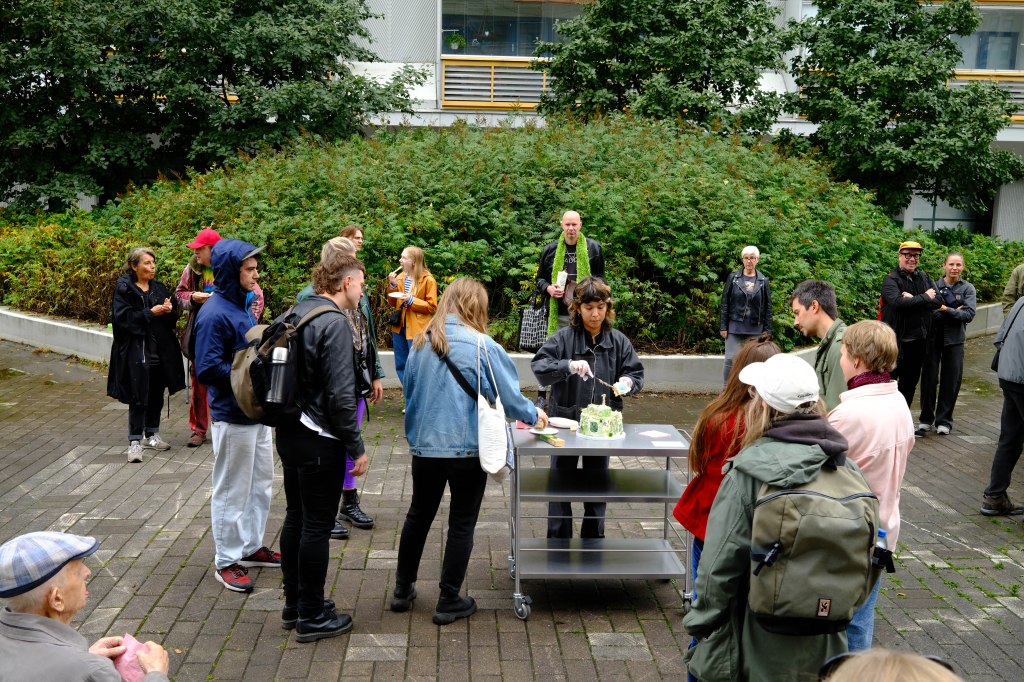
Another important focus is the space, because at the end, I am doing edible artworks that will be consumed. The way they are presented is very important and affects how people interact with them. It can be in a very low table in the centre, where everyone gathers around, or it can be scattered on the floor. But at the same time, because it is food, institutions sometimes get picky about what’s allowed and what isn’t. The aftermath of an edible installation can be a bit dirty and I need to take into consideration how it will affect the space.
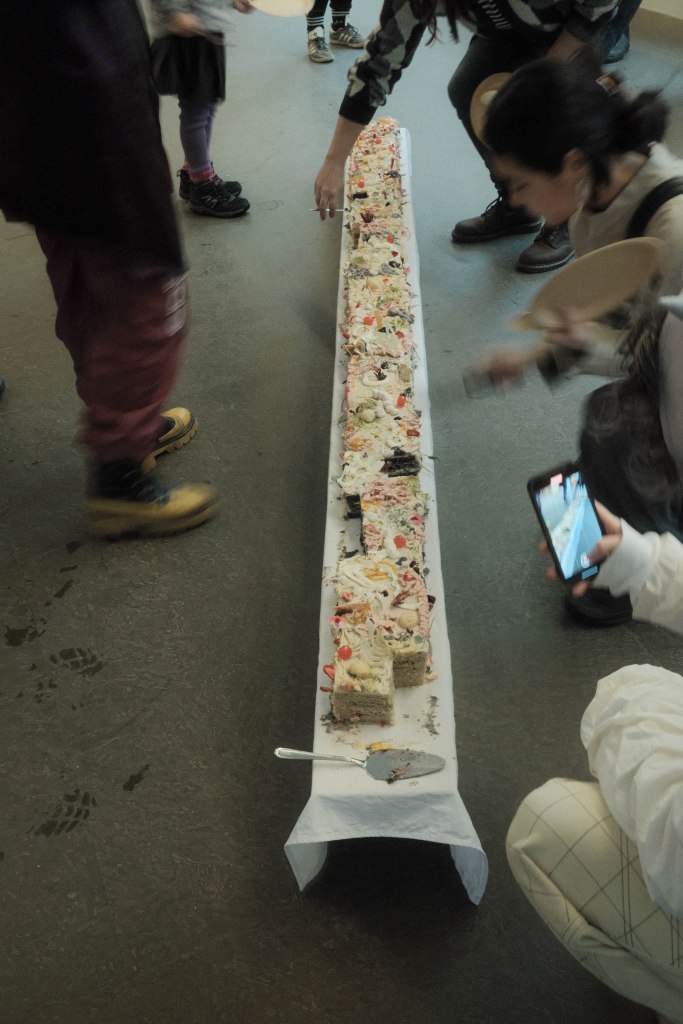
Helsinki, Finland
Photograph by Bogna Wisniewska.
Recipe as artistic instrument
Vanessa: Do you start with a finished recipe, or does it develop as you create the piece?
Alejandra: I guess it’s a mix of both things really. I do have recipes but they are not my own. I don’t really consider myself a recipe creator. I have written down some, but they are usually very simple. When I first started, I was using my grandmother’s recipes, but they are heavy, buttery cakes, so I have started experimenting with others that I found from books, magazines, and from Substack. There’s a Substack that I’m subscribed to from a really good bakery that I enjoy.
With some recipes, I tweak them a lot. I use them as a base and then I change them, like changing one ingredient with another to make it more local. Nowadays, I can tell if something is too liquid or needs more sugar or salt, so in that sense, I think there is space to experiment. I always keep a diary with all my projects, so I keep rewriting the recipes as I tweak them. So those recipes have really changed a lot through the years.
For some projects, I think recipes are really important, like in the project that was about memories from back home. For me, that was more about my mom’s recipes and how I could recreate them. Those recipes are not written down. They’re more like embodied knowledge that I acquired during my childhood from watching her, combined with my mom sending mea list of ingredients. But when I’m doing these big installations – maybe for 100 people – I start to see the recipes more as material formulas that help me create the artwork, especially when the final cake artworks look like a forest or a material that doesn’t really look like food.
Vanessa: Do you reuse recipes or are they always new in some way?
Alejandra: Yeah, I definitely reuse them. I mean, it’s really hard to test a lot of recipes, so once I find the one I like, I stick with it. I put a lot of labour into making and researching, and for me the process is also very important. Other people only see the final artwork, but behind that there are a lot of hours involved. I also value ingredients and homemade food a lot, so everything I put into the cakes is homemade. I make the jams, the fillings, and the curds myself. Everything I put into my artworks is always edible, there are no toxic flowers or anything.
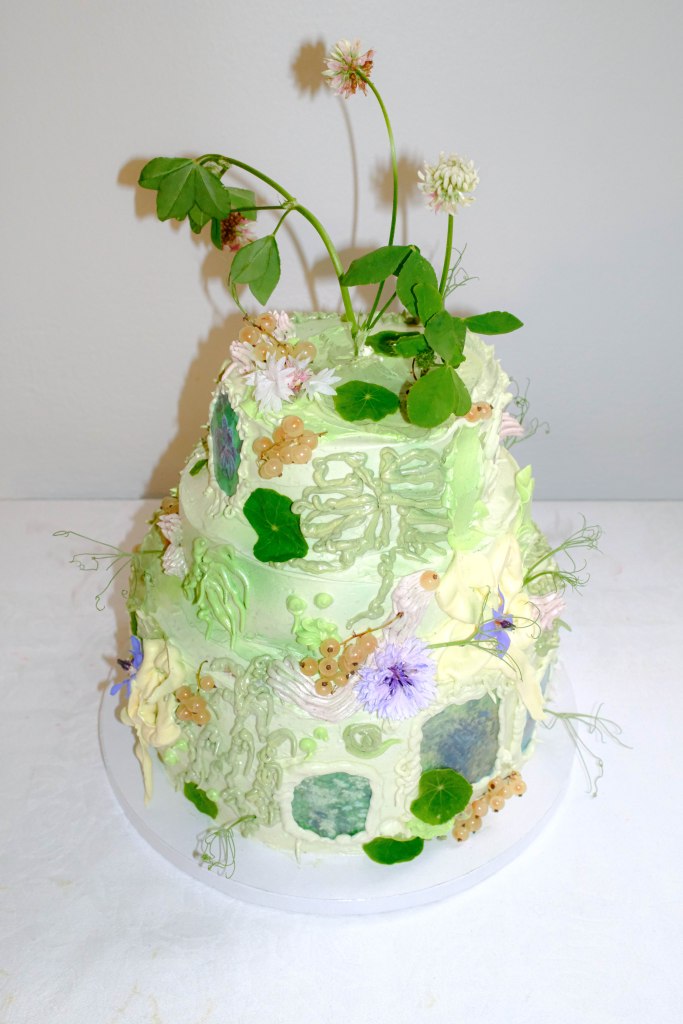
Helsinki, Finland
2025
Photograph by Alejandra Alarcón
From personal memory to shared experience
Vanessa: You mentioned that your memories and background influence your works and recipes. Are there any other factors that influence them?
Alejandra: I think sometimes my work can be really social or carry an ecological meaning, and food is an extremely political subject. Ingredients migrate with people, and they carry a lot of different histories of colonisation and displacement. With each ingredient I use, I’m always thinking: where does it come from? What history does it carry? Whose labour sustains it, or how did it arrive in Europe and in Finland? So that has influenced my work. Though it is not always my main focus, I do put a lot of value in the ingredients and where they come from. Also, food is common ground because we all need food to sustain ourselves, right? So in that way, I’ve been interested in approaching food as both an artistic and a cultural material.
There is also a lot of influence from my Mexican background – in the way I connect with food, in the way I’m used to eating with my hands, and in how there is always food in the center of the table and we all share and have these big meals, at least in my family. I think growing up with that has shaped how I see food and how I wish other people to experience the food installations I create, especially in more intimate settings. Living in Finland, the seasons also really affect my work. Not only what produce I use, but also how I work. In summer and autumn, I’m very active, but in winter I slow down and focus on other things that can be done inside. Then I’m not really focusing on producing, but more on recharging.
Helsinki, Finland
2025
Photograph by Manuel Díaz
Vanessa: Your artworks are meant to be consumed. Does the temporary nature of the work carry a message or a meaning? Is it important for them to be consumed together?
Alejandra: Definitely, I love that about food! Sometimes I wish the artworks didn’t have to disappear so fast, but most of the time I really enjoy it. I love creating things, but I don’t always enjoy the permanence of them being there forever, and I get tired of it. So when it’s consumed, I am really happy that it gets shared with other people.
For me, the act of eating is very important, and for the work to be fully experienced, it really needs to be consumed by other people. I love that people can just be present and enjoy the artwork. Most of the time, it’s in a communal setting where everyone is eating together, and for me that’s so incredible.
Art can feel so unapproachable sometimes for people outside of the art world, like how you engage with the artwork. But when you’re all eating it together, there’s already a bond created between everyone, and I love that idea. And for that to happen, you need to be present. Of course, there’s documentation of each artwork, but to fully experience it, you have to be there at that moment.
Vanessa: What role does flavour play in your work?
Alejandra: People often think that the cakes will probably taste bad because the focus is on the aesthetics, and they’re surprised that they actually taste good. I love that surprising effect on people when they try it, because I love that food – like art – is so subjective. I have done so many different flavours over the years, and I always get mixed opinions. Someone tells me it’s the best cake I have ever made, and someone else thinks it’s too sour. There are always going to be different opinions.
I’m always thinking about how the flavours turn out and whether people will like them, because of course I want to make something people will enjoy. At the same time, I am also trying to experiment and use flavours that are not too basic or too common, but something that you would only be able to try in my artworks, and then you can carry that flavour with you and still think about it months or years later.
Vanessa: What has been the most memorable reaction when people are invited to eat the artworks?
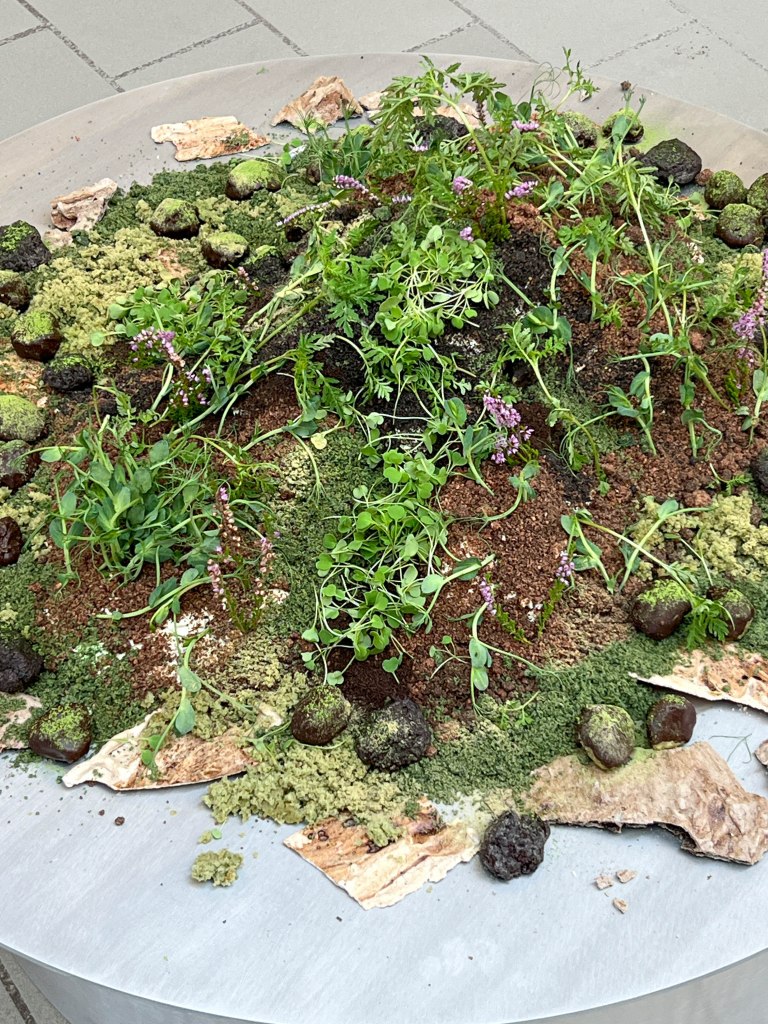
Alejandra: The most amazing reaction I have seen has been from children. Last summer, I created an edible installation inspired by the forest for Drifts Festival at Malmitalo. At the same time, there was also a children’s event happening in the courtyard.
I was decorating and creating the artwork in the lobby, and a lot of children were passing through. Everyone was so impressed and so surprised. They would stop and look at it, and they couldn’t believe it was edible. Then they would tell their parents, and their parents probably hated that, because as a kid you might think ‘okay, so then I can eat soil and rocks’ since that is what it looked like.
When I presented the artwork and everyone was invited to eat it, there were a lot of kids there, and their energy was so inspiring. The piece was inspired by the forest, so it had these large piles that looked like edible soil and lots of small rocks. I saw two kids who were only collecting the rocks, so they had a box full of edible rocks, and I just loved that! Sometimes you need that kind of energy to see things from a new perspective.
Helsinki, Finland
2025
Photograph by Alejandra Alarcón
Vanessa Uhlbäck
 Nyyh
Nyyh 